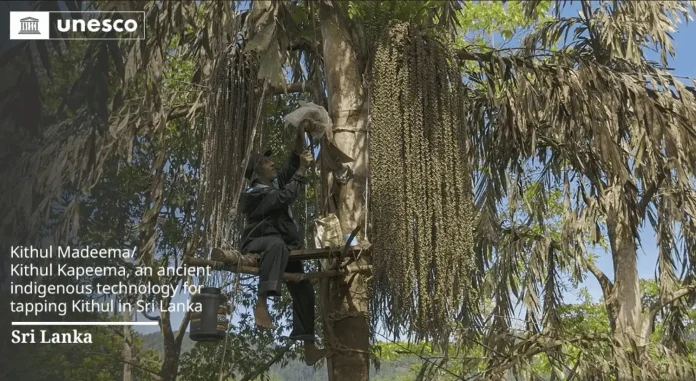
Sri Lanka’s traditional practice of Kithul Madeema, also known as Kithul Kapeema, has been officially inscribed on the UNESCO Representative List of the Intangible Cultural Heritage of Humanity. The decision was announced on 11 December during the 20th Session of the Intergovernmental Committee for the Safeguarding of the Intangible Cultural Heritage, held in New Delhi, India.
Kithul Madeema is an ancient indigenous technology used to extract sap from the kithul palm (Caryota urens), a tree endemic to Sri Lanka. The practice has been passed down for centuries among rural communities and requires advanced skill and deep ecological knowledge. Tappers identify mature palms, climb tall trees, prepare and wrap the flower stalk, and delicately tap it using a sacred knife. Sap is collected daily, filtered, and boiled to produce kithul treacle (pani), jaggery (hakuru), vinegar and other food products that hold a central place in Sri Lankan cuisine and ritual life.
The tradition is currently practiced across more than 13 districts in the Southern, Central, Sabaragamuwa and Uva Provinces. It is found in forested areas as well as home gardens, reflecting a close relationship between people and their natural surroundings.
Following the adoption of the decision (20.COM 7.b.40), Minister Counsellor of the High Commission of Sri Lanka in New Delhi, Wathsala Amarasinghe, expressed Sri Lanka’s deep appreciation to the UNESCO Evaluation Body and Secretariat. She highlighted the importance of this recognition for rural communities and traditional tappers who continue to safeguard and transmit this knowledge system.
UNESCO noted that the inscription will increase the visibility of the practice, strengthen rural livelihoods, encourage youth participation, and support sustainable cultural practices rooted in environmental stewardship.
The nomination was submitted under file number 02318, with documentation available in multiple languages, including English, French and Sinhala. Like all elements on the Representative List, Kithul Madeema will be included in Sri Lanka’s periodic reporting to UNESCO every six years, ensuring continued safeguarding and community involvement.
This inscription marks a major milestone in Sri Lanka’s efforts to preserve its living heritage and honors the creativity, resilience and environmental knowledge of kithul tapping communities.
Reference links
- UNESCO element page: https://ich.unesco.org/en/RL/kithul-madeema-kithul-kapeema-02318
- UNESCO Representative List: https://ich.unesco.org/en/REPRESENTATIVE-LIST
- UNESCO ICH Convention: https://ich.unesco.org/en/convention